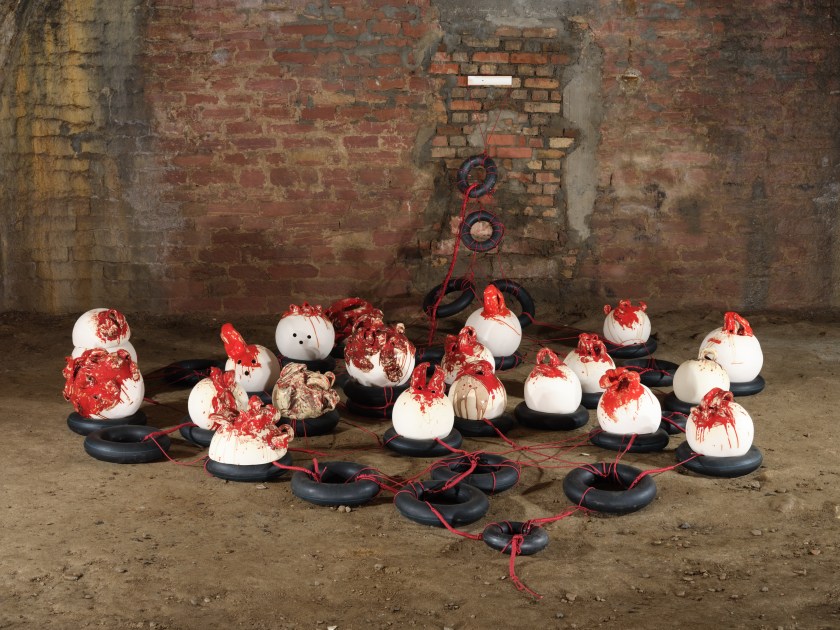
«FISCHERHALLE_ ÜBER DIE TIEFEN DES FLUSSES« _DAS ROTE FLOSS
Site-specific installation at the Historical Fischerhallen, Frankfurt am Main
Glazed ceramics Objects, parachute cord, 33 wheelbarrows
Variable dimensions.
Frankfurt am Main, Germany
2026
FISCHERHALLE_ Sobre la profundidad del río, 2026_ LA BALSA ROJA
En el corazón de un lugar con doscientos años de historia se encuentran las Fischerhallen: salas abovedadas de unos 400 metros cuadrados, construidas en 1826. En aquel momento, estas cuatro bóvedas se asentaban directamente sobre el agua y estaban conectadas con el río Meno a través de estrechos canales. Era allí donde los pescadores amarraban y reparaban sus barcas, y donde guardaban sus redes y aperos. Un acceso directo las conectaba además con la Große Fischergasse, un nombre de calle que aún hoy atestigua la conexión vital entre la ciudad y el espacio de trabajo de los pescadores en el río. Como propuesta de sitio específico (site-specific), la instalación entabla un diálogo directo con este espacio, su arquitectura y su resonancia histórica.
El agua en sí misma no tiene profundidad; la profundidad es una experiencia del cuerpo. Es ese preciso momento de umbral en el que los pies pierden el contacto con el suelo y la respiración, hasta entonces automática, se convierte en un acto consciente de supervivencia. Es el tiempo suspendido entre ceder al hundimiento y el esfuerzo por mantenerse a flote.
Bajo esta premisa, el proyecto concibe un espacio impregnado por esta tensión: aquello que se hunde y aquello que sostiene; lo que se pierde en lo invisible y lo que marca límites en la superficie. Aquí, las boyas flotan y las cuerdas se tensan; se sitúan en ese umbral donde la línea que conecta se convierte, simultáneamente, en la línea que limita. En el río, estas señales marcan zonas seguras o prohibidas; en el cuerpo, la tensión marca el límite entre sostenerse y romperse. Habitar esta profundidad no significa un descenso sin retorno, sino más bien la aceptación de la inestabilidad como única condición.
En la Fischerhalle, las esferas se conectan en líneas continuas que se cruzan para formar una red suspendida. Si un telar es una estructura basada en la firmeza necesaria para que el tejido exista, aquí estas cadenas de boyas funcionan como un sistema normativo de urdimbre que traza trayectorias y condiciona el movimiento de los visitantes. Sin embargo, la instalación subvierte esta estructura técnica para volverla sensible. Las esferas no son neutras: de cada una de ellas emerge una lengua —el órgano de la palabra, del gusto y del exceso— introduciendo la vulnerabilidad en la geometría de la señal. Junto a ellas, unos guantes de cerámica aparecen como fantasmas, evocando el trabajo humano y el de aquellos pescadores: huellas de tradiciones y oficios en riesgo de disolverse y perderse en el paso del tiempo. Donde el sistema exige claridad y función, emerge la vulnerabilidad de un cuerpo y su memoria.
Entre la deriva y el anclaje, entre la norma y las huellas del oficio, entre el olvido y la tradición, la obra nos cuestiona:¿Qué significa habitar un espacio regulado? Y ¿qué tensiones sostienen en silencio todo aquello que parece estable?
“LA BALSA ROJA” (DAS ROTE FLOß) es una instalación de sitio específico (site-specific) creada para el proyecto “FISCHERHALLE_ Sobre la profundidad del río” (2026), realizada con el apoyo del Kulturamt Frankfurt y organizada por B22_ y MAKING FRANKFURT.
***
FISCHERHALLE_ On the Depth of the River, 2026_THE RED RAFT
At the heart of a site with two hundred years of history lie the Fischerhallen: vaulted halls covering approximately 400 square meters, built in 1826. At that time, these four vaults sat directly in the water and were connected to the Main River via narrow channels. It was whe- re fishermen moored and repaired their boats, and where they stored their nets and tools. A direct access route also connected to the Große Fischergasse, a street name that still bears witness today to the vital connection between the city and the fishermen’s workplace on the river. As a site-specific proposal, the installation engages in a direct dialogue with this space, its architecture, and its historical resonance.
Water in itself has no depth; depth is an experience of the body. It is that precise threshold moment when the feet lose contact with the ground and breathing, until then automatic, becomes a conscious act of survival. It is the time suspended between yielding to the sink and the exertion of staying afloat.
Under this premise, the project conceives a space permeated by this tension: that which sinks and that which supports; that which is lost in the invisible and that which marks boundaries on the surface. Here, buoys float and ropes tauten; they locate themselves at that threshold where the connecting line simultaneously becomes the limiting line. In the river, these sig- nals mark safe or forbidden zones; in the body, the tension marks the boundary between holding and breaking. Inhabiting this depth does not mean a descent without return, but rather the acceptance of instability as the sole condition.
In the Fischerhalle, the spheres connect into continuous lines that intersect to form a suspended web. If a loom is a structure based on the firmness required for fabric to exist, here these chains of buoys function as a normative warp system that traces trajectories and conditions the movement of visitors. Yet the installation subverts this technical structure to render it sensitive. The spheres are not neutral: from each of them emerges a tongue — the organ of speech, taste, and excess — introducing vulnerability into the geometry of the signal. Beside them, ceramic gloves appear like ghosts, evoking human labor and that of those fishermen: traces of traditions and crafts at risk of dissolving and losing themselves in the passage of time. Where the system demands clarity and function, the vulnerability of a body and its memory emerges.
Between drifting and anchoring, between the norm and the traces of craft, between forget- ting and tradition, the work questions us: What does it mean to inhabit a regulated space? And what tensions are silently sustained by all that appears stable?
“DAS ROTE FLOSS” is a site-specific installation created for the project “FISCHERHALLE_On the Depth of the River” (2026), supported by the Kulturamt Frankfurt and organized by B22_ and MAKING FRANKFURT.
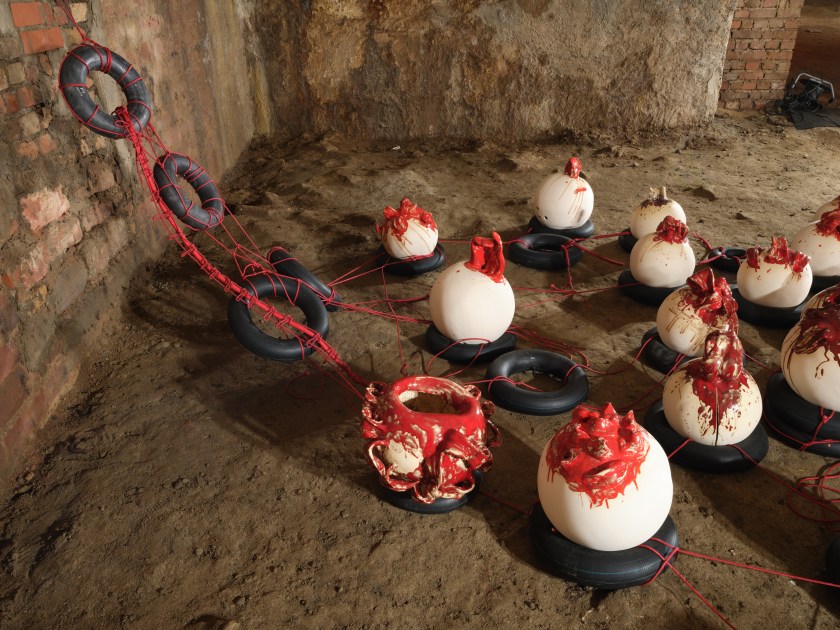
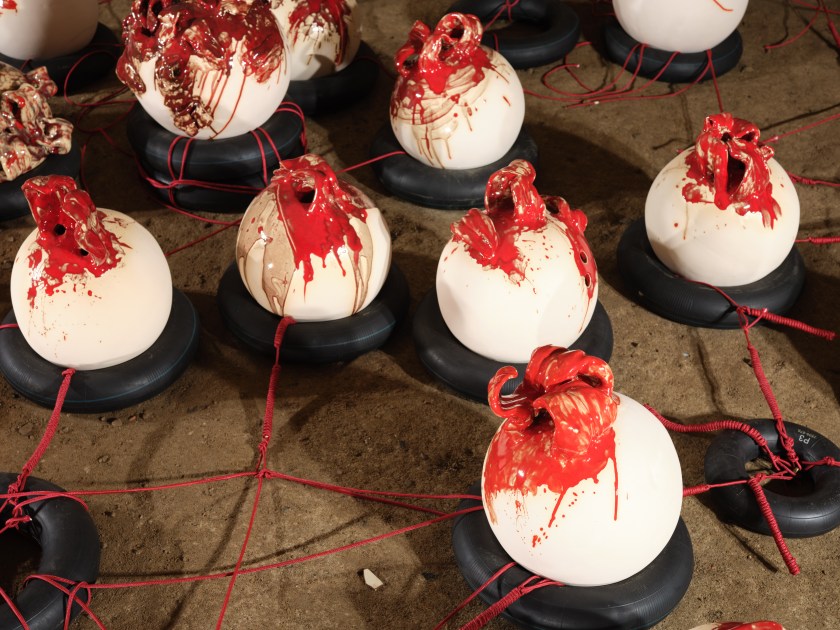
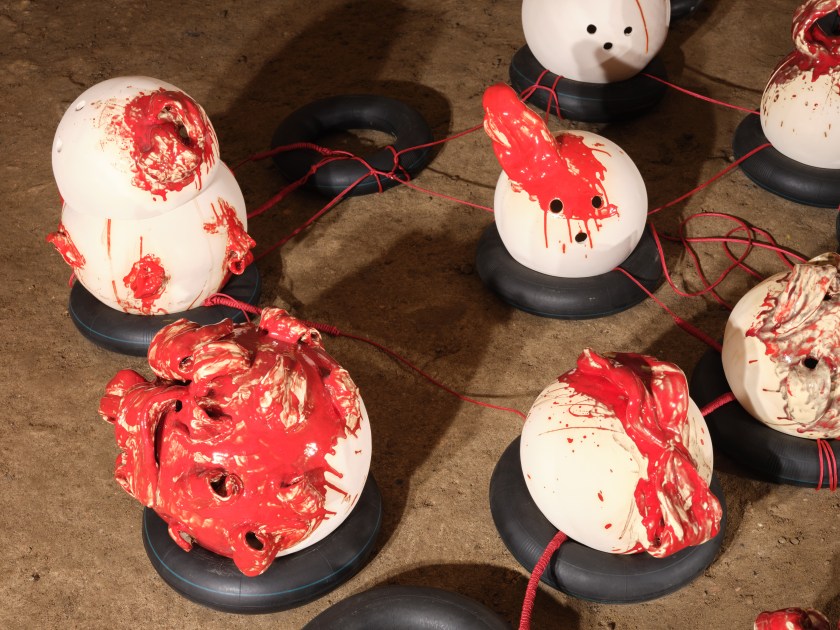
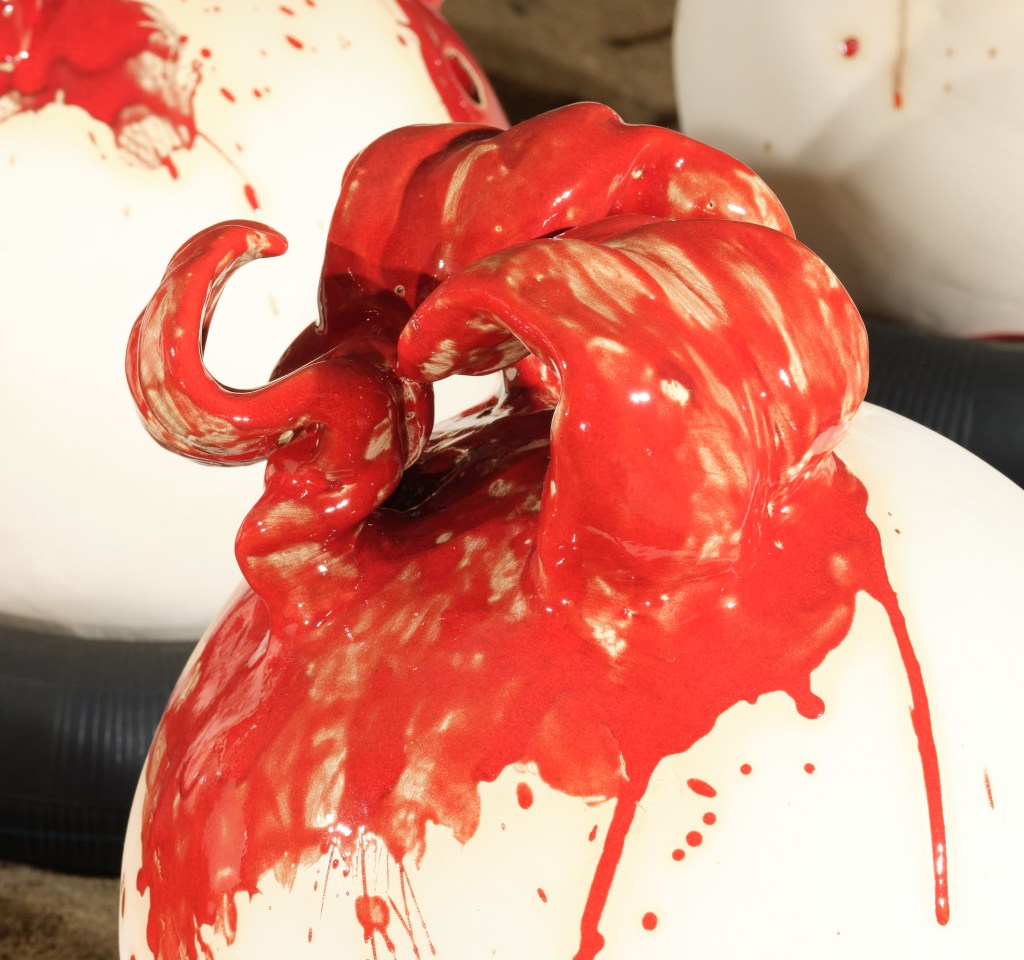
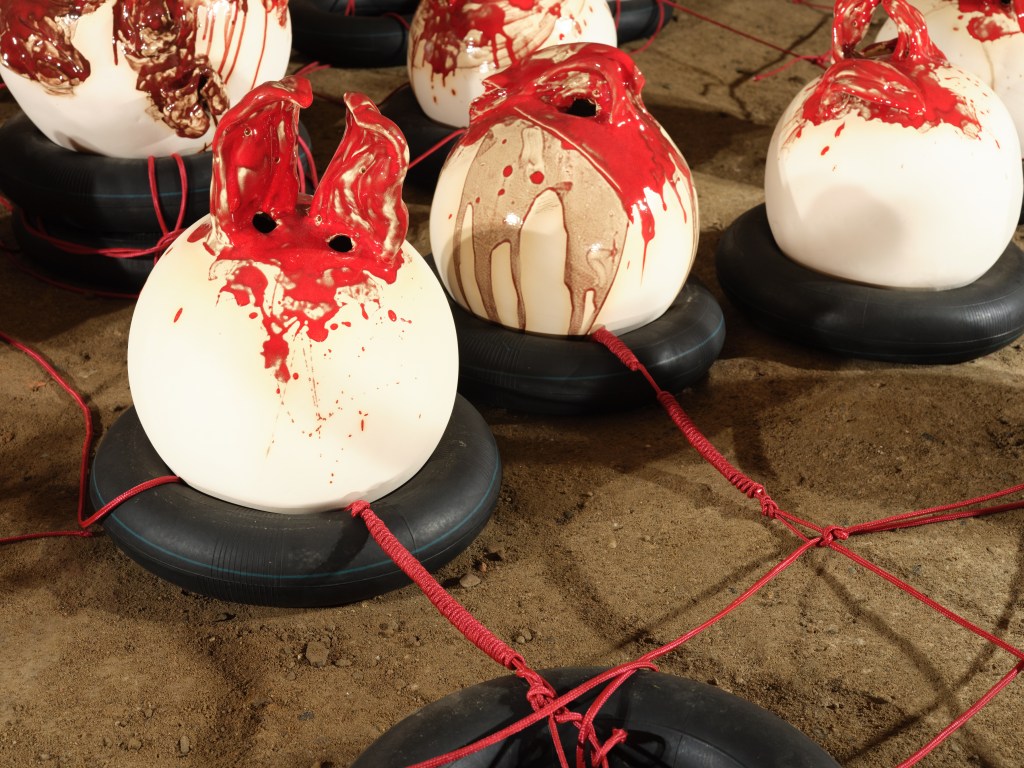
» THE RED RAFT » Site-specific installation detail Object view
photography: Martin Url
VERÓNICA AGUILERA CARRASCO

